Friday, December 28, 2012

"All diseases run into one, old age" -Ralph Waldo Emerson

Humanity is facing a challenge with profound implications in all aspects of life. If you pay attention to the media you're probably thinking climate change or the worldwide economic crises are paramount, but there is another issue which, in my humble opinion, trumps them all yet receives little to no recognition; aging.

As standards of living rise in developing nations and healthcare interventions continually improve the quality and duration of life, limited natural resources and rising prices of those aforementioned life-extending technologies will rear their ugly heads. Another phenomenon to take heed of is population aging. People are not just living longer, but the number and proportion of the elderly population is getting larger. The per-capita cost of maintaining health in the elderly is significantly more than for a younger person, and like a see-saw with a fat kid on one end and a little runt on the other, the costs of maintaining social health programs (like medicare and medicaid in the US) will far outweigh the funds and subsidies provided by tax revenue from the younger, working class.


With that in mind, I think basic research on the molecular properties of aging are vital for discovering potential 'fountains-of-youth' - interventions for extending healthy life span, key word being healthy and implying drastic reductions in cost. At the cellular level, one characteristic of aging being studied is dysfunction in the maintenance of proper-functioning DNA. The human body is composed of trillions of human cells (and even more bacterial cells) which maintain functionality throughout life by replicating DNA and forming new cells (just like periodic oil changes keep a car running smoothly). This process, called mitosis, is tightly controlled by cells and is susceptible to age-associated malfunctions leading to genomic instability and tumorigenesis (normal cells becoming cancerous). Research at the Mayo Clinic identified a gene involved in the mitotic pathway - BubR1 - whose decreased expression (remember DNA -> RNA -> Protein from basic Biology? Decreased expression is less DNA -> RNA) in mice is associated with age-related dysfunction in multiple organs "including heart, muscle, kidney and eye". More importantly, increasing the expression of BubR1 (more DNA -> RNA) prevented these issues and the mice were healthier for longer. So what? What's the big deal with helping mice live longer? Well, human DNA also contains the BubR1 gene and if a decreased expression can be associated with aging, voila.

While this discovery may not be the 'straw that breaks the camel's back' for healthy aging research, it does contribute to our understanding of the complex process (and problem) that is aging. And maybe, just maybe, with a bit of luck and a lot of determination, could someday help us turn back the clock and raise that overweight see-saw'er off the ground.



Thursday, December 27, 2012

Risk vs. Reward: stem cells & gene therapy in the womb

http://www.sigmaaldrich.com/life-science/stem-cell-biology/ipsc.html
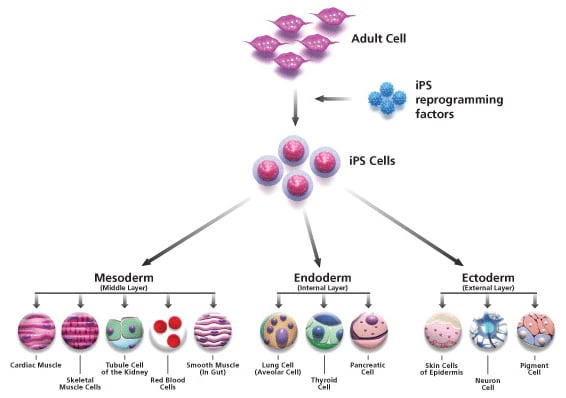
Stem cells are being studied in a regenerative, cell-based capacity to treat many different conditions - insulin-producing beta cells for Type I diabetics, retinal epithelial cells to restore vision in the blind, and cardiomyocytes to repair severely damaged hearts just to name a few. Imagination seems to be the limit for the potential applications of stem cells to treat most of the diseases and maladies we experience.

A new medical procedure, highlighted in Meera Senthilingam's article in NewScientist 'Fetal healing: Curing congenital diseases in the womb', combines the pluripotency (ability to become virtually any cell and tissue type) of stem cells with gene therapy techniques (ability to introduce or remove specific sequences of DNA) and holds the promise of curing congenital diseases (diseases associated with known genetic mutations such as cystic fibrosis & sickle-cell anemia). The treatment is being extensively tested in animals for safety and effectiveness, but could become reality for humans in 5-10 years.

The prospect of preventing stillbirths and infant-deaths, and eliminating the suffering of people with debilitating illnesses is incredible, but could also open the door for unnecessary or enhancing genetic manipulations. I'm excited to see how this incredible technology progresses, but with moral and ethical implications attached, I think public education and discussion are crucial to its successful implementation.


Wednesday, December 26, 2012

"Call me Ishmael" - Moby Dick & 'The Science Tide'

There is a quote from Herman Melville's novel 'Moby Dick' which had a profound impact on me.

"Me thinks that in looking at things spiritual, we are too much like oysters observing the sun through the water, and thinking that thick water the thinnest of air."

In the context of the 19th century American classic, this line refers to those who are religiously-inclined believing that their beliefs are true and absolute, whereas faith is in fact a personal interpretation, blurred to the eye of the beholder.

I feel the same is true for science. If the sun represents scientific proof and we humans are the oysters, the water dividing us is the limitations of our technology to study and understand the world around us. As we as a species and civilization progress, so too does our capacity to comprehend the scientific properties which dictate our life in the universe.

Unlike Melville's oysters however, we have the capacity to accept the watery divide, gradually and methodically thinning the aqueous layer by technological advances, revealing a clearer picture of that which we observe.

It is these advances in technology and the scientific discoveries they lead to which interest me, and provide answers to the seemingly infinite unknowns of the world which we inhabit. The tools we employ to validate (or refute) scientific principles are just like the ocean tides dictating the shoreline.

It is my goal with this blog to entertain, educate, and hopefully spark an interest in the exciting flow of 'The Science Tide'.