Wednesday, March 20, 2013

Animations: the future of science education?


Maybe it's just my inner-nerd speaking but I really wish professors during my undergraduate training had used animations like the one above in their lectures. Not only is it filled with the same information that can be found in a textbook or on a lecture slide, but it is engaging and entertaining (especially {spoiler alert} when the neutrophil explodes). Unlike subjects such as math or literature, science, and in particular biology, involve movement and ever-changing/evolving entities and processes. So why teach a constantly-in-motion concept with stagnant lecture notes or diagrams when an animation or film clip is available?
I think it's time for education to embrace and implement technological developments. But, don't just take my word for it. Compare the figure below from Terminology: nomenclature of mucosa-associated lymphoid tissue by P Brandtzaeg, H Kiyono, R Pabst and M W Russell to the posted video and see for yourself.


Depiction of the human mucosal immune system. Inductive sites for mucosal immunity are constituted by regional mucosa-associated lymphoid tissue (MALT) with their B-cell follicles and M-cell (M)-containing follicle-associated epithelium through which exogenous antigens are transported actively to reach antigen-presenting cells (APCs), including dendritic cells (DCs), macrophages, B cells, and follicular dendritic cells (FDCs). In addition, quiescent intra- or subepithelial DCs may capture antigens at the effector site (exemplified by nasal mucosa in the middle) and migrate via draining lymphatics to local/regional lymph nodes where they become active APCs, which stimulate T cells for productive or downregulatory (suppressive) immune responses. Naive B and T cells enter MALT (and lymph nodes) via high endothelial venules (HEVs). After being primed to become memory/effector B and T cells, they migrate from MALT and lymph nodes to peripheral blood for subsequent extravasation at mucosal effector sites (exemplified by gut mucosa on the right). This process is directed by the local profile of vascular adhesion molecules and chemokines, the endothelial cells thus exerting a local gatekeeper function for mucosal immunity. The gut lamina propria contains few B lymphocytes but many J-chain-expression IgA (dimers/polymers) and IgM (pentamers) plasmablasts and plasma cells. Also, there are normally some rare IgG plasma cells with a variable J-chain level (J), and many T cells (mainly CD4+). Additional features are the generation of secretory IgA (SIgA) and secretory IgM (SIgM) via polymeric Ig receptor (pIgR) membrane secretory component(mSC)-mediated epithelial transport, as well as paracellular leakage of smaller amounts (broken arrow) of both locally produced and plasma-derived IgG antibodies into the lumen. There may also be some active transport of IgG mediated by the neonatal Fc receptor (not indicated). Notes that IgG cannot interact with J chain to form a binding site for pIgR. The distribution of intraepithelial lymphocytes (mainly T-cell receptor alpha/beta+ CD8+ and some gamma/delta+ T cells) is also depicted. The insert (lower left corner) shows details of an M cell and its "pocket" containing various cell types. The cartoon is modified from Brandtzaeg and Pabst with permission from Elsevier.

Thursday, March 14, 2013

The Price is Right...for curing disease and extending life

Yamaha by Delta Spirit from the Warm Bodies Soundtrack (great movie btw)


What is the best way to promote research aimed at curing intractable diseases and extending human life? For a group of sponsors including Facebook founder and CEO Mark Zuckerberg and Apple chairman Art Levinson, the answer is to incentivize breakthroughs with a $3 million prize. The Breakthrough Prize in Life Sciences is awarded 5 times annually, "for past achievements in the field of life sciences, with the aim of providing the recipients with more freedom and opportunity to pursue even greater future accomplishments."
http://graphics8.nytimes.com/images/2013/02/26/science/26WEEK3/26WEEK3-popup.jpg 
Previous winners include Shinya Yamanaka for research on induced pluripotent stem cells, and Eric S. Lander for enabling the identification of human disease genes in a medically relevant manner. There have been 11 winners of the prize so far, all of whom reside on the committee to review and select future awardees, who then join the selection committee.

I think this award is not only a great promotion of cutting edge, significant research aimed at the biggest health concerns of today - namely cancer and aging - but, also an excellent opportunity to get the general public interested and involved. Thinking about those most famous in the public eye, you would be hard pressed to find a person who could name a research scientist or doctor. While athletes, musicians, actors, and politicians dominate the pop culture landscape, it's time to look at the bigger societal picture and really give credit and prominence to those who deserve it.
                                                              
Here is an excellent blog post by @GrrlScientist on why the prize may not be so great and how it could be modified to more effectively promote research.
http://www.guardian.co.uk/science/grrlscientist/2013/feb/21/breakthrough-prize-life-sciences-misguided-flawed
While I agree with much of what is said about not acknowledging everyone involved in collaborative research efforts, I believe that acknowledging a sole scientific leader sticks in peoples minds more so than a large group and helps bring science mainstream with an identifiable spokesperson.

Friday, March 8, 2013

To infinity and beyond...genomics

Freedom by Anthony Hamilton & Elayna Boynton from Django Unchained

In the words of Dr. Raul Urrutia, an epigeneticist at the Mayo Clinic in Rochester, Minnesota "DNA gives us the potential to be who we are, but Epigenomics transform this potential into the reality of who we are."

The human genome project was an incredible achievement in the history of science and advanced our understanding of the molecular basis of life and evolution. With the promise of revolutionizing medical diagnoses and treatments, the collection of genomic data and subsequent analysis is leading the slowly emerging personalized and individualized medical field, but is really just the tip of the iceberg in terms of fully comprehending the molecular complexities of disease and therapies.

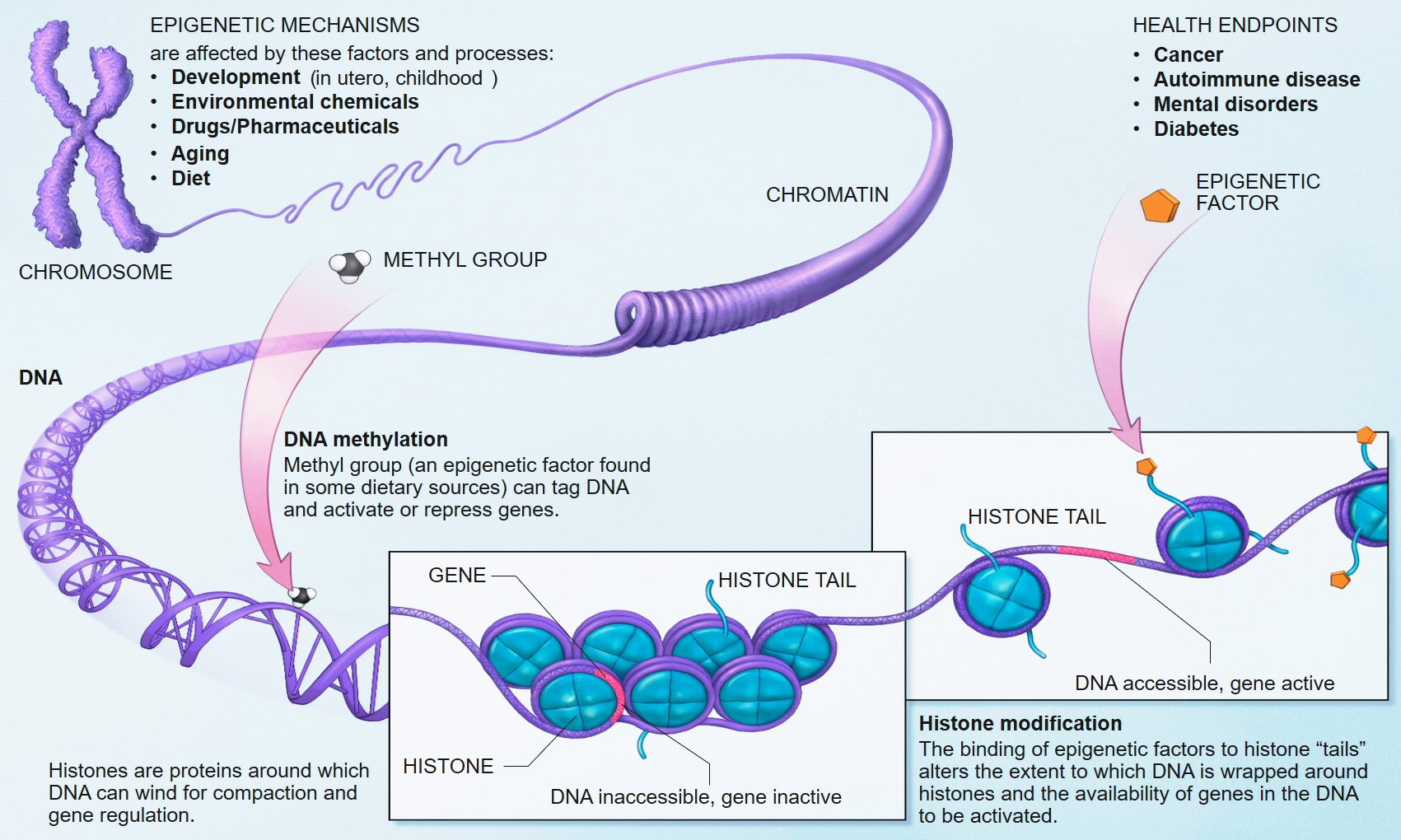
File:Epigenetic mechanisms.jpg
http://commonfund.nih.gov/epigenomics/figure.aspx
Thinking about the development of a human, our DNA when we are an embryo is largely the same as the DNA when we are babies which is the same as our adult DNA. Despite this genetic consistency, we take on drastically different forms at various life stages. These changes, not due to alterations in the genetic code, are dictated by other heritable traits responsible for the correct level, place, and time of gene expression. These Epi(above)-genetic factors constitute the link between the changing environment and the cell's ability for adaptation.

While exceedingly complex and difficult to research, breakthroughs in epigenetics are sure to improve our understanding of the molecular regulation of cellular processes, and bring us closer to solving health issues ranging from infection and disease to degeneration and aging.